The Barcham Family


More Voyages

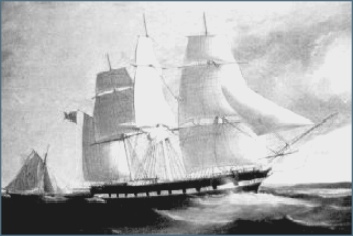
John Bridgford and his wife, Emily (née Honeybone) and two children, Harriet and Joseph, emigrated with other families of the Fourth Detachment of the Royal New Zealand Fencible Corps - 78 pensioners, 63 women and 114 children - aboard the Sir George Seymour. They sailed from Gravesend on 12 August, and arrived on 27 November 1847, a passage of 108 days. Their four-month old son, Joseph, was among the nine children under five years of age who died on the voyage, which is described in The Royal New Zealand Fencibles, 1847-1852. John and Emily's granddaughter, Florence Bridgford, married Leslie Barcham Shalders, son of Herbert Shalders.


wpd0a7fb75_0f.jpg
Herbert Shalders, son of Anne and John Shalders of Southampton, emigrated to New Zealand in 1884, aged 18 years, aboard the SS Florida. The passage to New Zealand took 46 days, leaving from Plymouth on 15 January and arriving at Auckland on 9 March. Not only were there fewer days at sea, the conditions on board were much better than hitherto. Herbert wrote a diary during the voyage (now in the possession of his granddaughter). Apart from some bouts of sea-sickness, Herbert seems to have enjoyed the experience. The diary shows that emigrant ships to Australia and New Zealand were still going via Madeira and the Cape Verde Islands in the 1880s, even though the Suez Canal was opened in 1869. For vessels that used steam power to supplement sail, the Atlantic and southern Indian Ocean route must have been quicker and/or more economical with respect to fuel for these steam/sailing ships.
William Henry Barcham, eldest son of Henry Barcham, and his wife Bethia, sailed from Melbourne aboard the P&O liner Persia on 12 February 1912. The Persia, launched on 13 August 1900 at Caird and Company's yard, Greenock is described in P&O, A Fleet History as a passenger liner, 7951 tons gross, with a triple-expansion four-cylinder, 11,000 ihp engine. The maximum speed was 17 knots, and capacity 320 first-class, 160 second-class passengers. She had two funnels, two decks and a spar deck (teak) and electric lights. The sinking of the Persia on 30 December 1915 is described in another book, The Story of P&O.

The Sir George Seymour


wp4b33748e.png